Learn how BsAbs and CAR T cells work
An Introduction to BsAbs
- Antibodies are Y-shaped proteins and are normally made by the immune system. Antibodies recognize and bind to harmful substances such as bacteria and viruses1
- BsAbs are modified so that one arm of the Y binds to a target on myeloma cells, while the other arm binds to a different target on T cells. T cells are a type of immune cell capable of killing infected or cancerous cells. Note, the target on myeloma cells may also be present on other cells2,3
- When T cells and myeloma cells are bound by the BsAb, the T cell is activated, causing it to release chemicals to destroy the myeloma cell2
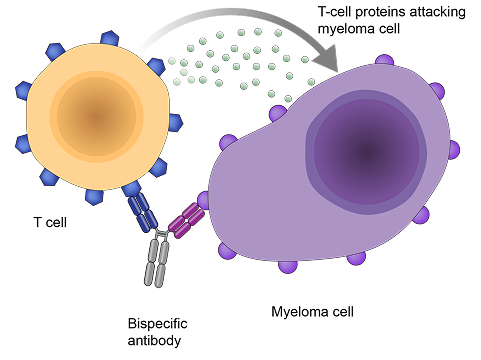
Figure adapted from: https://healthtree.org/myeloma/guides/bispecific-antibodies/bispecific-antibodies-myeloma-guide-understanding-bsab.3
An Introduction to CAR T-cell Therapies
- CAR T-cell therapies use T cells collected from the patient and modified to make proteins called chimeric antigen receptors, or CAR proteins, that can bind to myeloma cells4
- These cells, now called CAR T cells, are then reintroduced to the patient4
- In the body, CAR T cells recognize and bind to myeloma cells, leading to myeloma cell death4
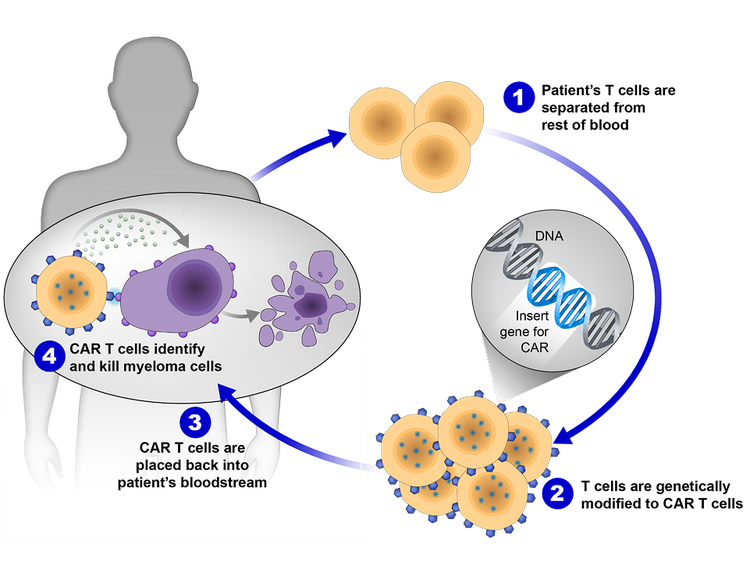
Figure adapted from: Luo J, Zhang X. Challenges and innovation in CAR-T cell therapy: a comprehensive analysis. Front Oncol. 2024;14:1399544.5
References
- Health Library. Antibodies. Cleveland Clinic. Accessed October 10, 2025. https://my.clevelandclinic.org/health/body/22971-antibodies.
- Devasia AJ, Chari A, Lancman G. Bispecific antibodies in the treatment of multiple myeloma. Blood Cancer J. 2024;14(1):158.
- Understanding bispecific antibodies. HealthTree Foundation. Accessed October 10, 2025. https://healthtree.org/myeloma/guides/bispecific-antibodies/bispecific-antibodies-myeloma-guide-understanding-bsab.
- Miller K, Hashmi H, Rajeeve S. Beyond BCMA: the next wave of CAR T cell therapy in multiple myeloma. Front Oncol. 2024;14:1398902.
- Luo J, Zhang X. Challenges and innovation in CAR-T cell therapy: a comprehensive analysis. Front Oncol. 2024;14:1399544.